


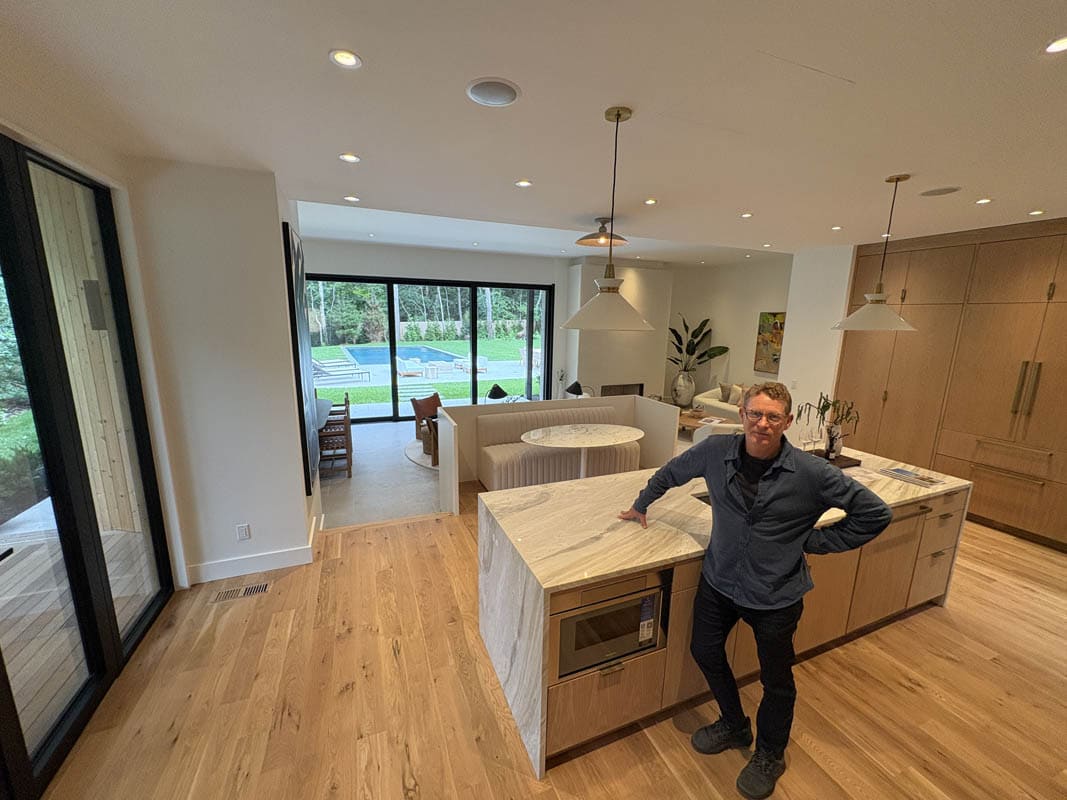
A long-time champion of land conservation and sustainability on the East End, Saunders agent Krae Van Sickle’s green advocacy runs deep. From his early exposure to environmental thinking from a life science teacher mother to traveling to Albany in the mid-1990s to successfully lobby for the creation of the Community Preservation Fund (CPF) alongside early conservation pioneers, to his ongoing work on the town’s Sustainability Committee and grass-roots groups like Drawdown East End, he has spent his career proving that the “goose that lays the golden egg” out here is our beautiful natural environment. I sat down with Van Sickle at his listing in Barnes Landing to discuss how the real estate community can act as vital gatekeepers, the importance of local reliance, and what it means to build on a human scale.
You have been involved with land conservation and sustainability efforts on the East End for many years. What first drew you to environmental stewardship here, and what keeps you engaged today?
Krae Van Sickle: “My focus (and that of my partner Lylla Carter) has been to a large extent on the beauty and special nature of the spots, of the beautiful locations on the east end. My main thrust, I would say to this day, is that there’s this great value stack, this great confluence of benefits that come from, simply stated, local self-reliance. Local self-reliance is going to give us resilience, and it’s going to give us better environmental outcomes.”
Tell me what self-reliance looks like in terms of food and water.
Krae Van Sickle: “Food is another huge base layer that has a lot of implications locally for self-reliance. Lylla and I have had a bunch of efforts to put enhanced development rights so that food is the only thing [grown on agricultural land], and that’s very tough. And then there’s water. Water is the other major thing. We have this great aquifer that’s replenished from the rains and so forth that needs to be protected through public policy.”
How do the choices we make in our own backyards and lawns impact the broader community and our local water quality?
KVS: “There are so many compelling economic arguments for doing the appropriate thing now. The real essence of it is, your property values depend on being able to safely swim and drink the water, and that, in turn, depends a lot on what you do in your landscaping and your lawn. It’s that simple.”
When you are looking at sustainable home construction, where do you actually begin to reduce a property’s carbon footprint or heating demands?
Krae Van Sickle: “Quality versus quantity. It’s as simple as that. Luxury is in the textures and the visual. Design matters. Quality design. The first thing you start with is the envelope. When you have a super-insulated envelope, then the requirement is reduced, so you don’t have to have a boiler that’s burning something at thousands of degrees in order to heat a house.”
Which sustainability features are becoming most desirable among buyers?
Krae Van Sickle: “Indoor air quality, like non-VOC paints and composites for cabinetry and carpeting and textiles. Those things carry a lot of nasty stuff, including PFAS in them. And then, of course, all the energy systems, solar just makes sense. Heat pumps are now the most efficient—they don’t cost any more capital cost to put in, and they are up to six times more efficient in terms of operating expenses. You have these hyper-heat heat pump technologies that are good to subzero temperatures.”
Tell me about the house we are in now. What is sustainable or environmentally responsible about it?
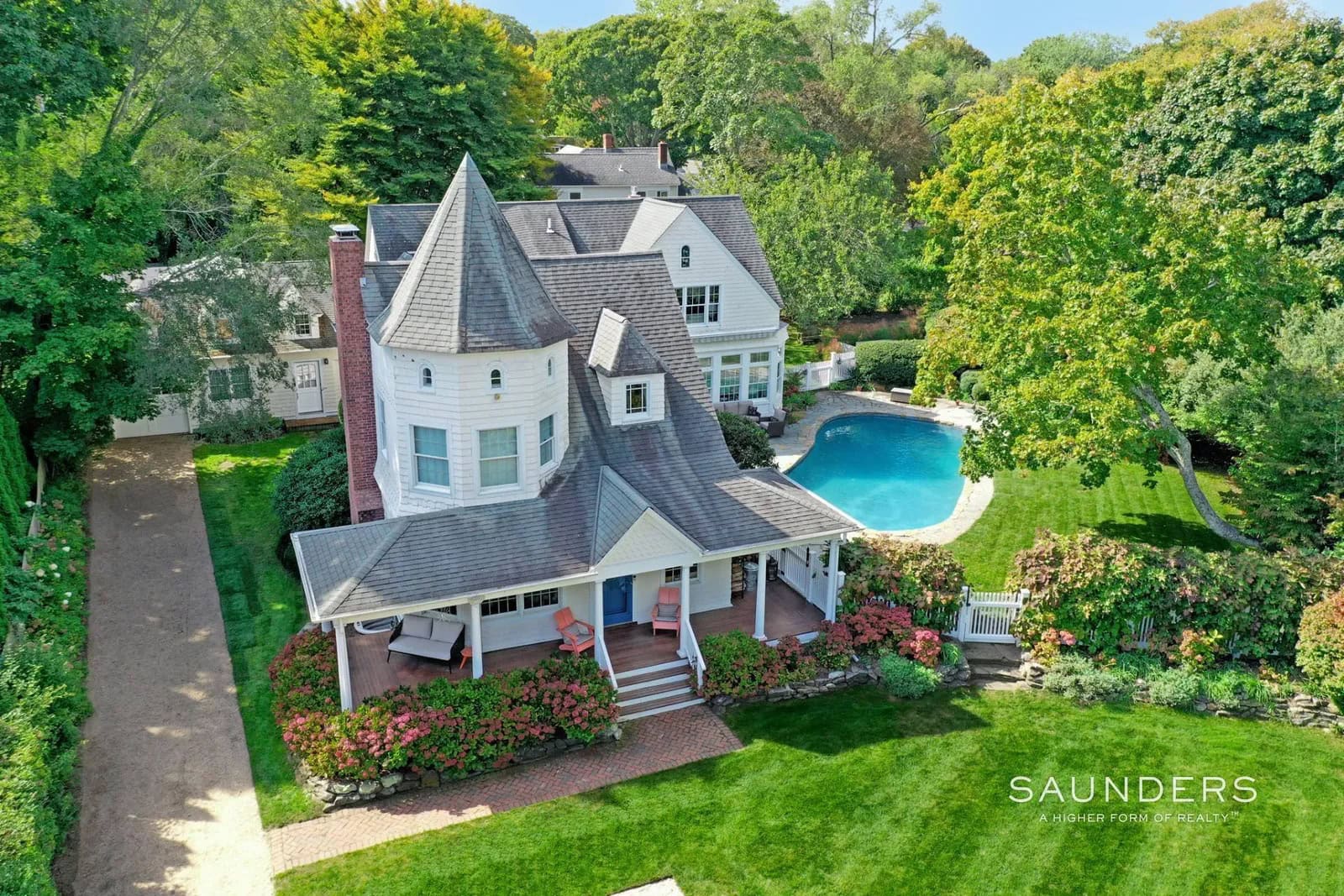
KVS: “What’s so cool about this house is that you can be in the kitchen because it has this big, 20-foot nano door that disappears into the wall, and you can relate to everybody who’s in the living space and who’s out on the patio and next to the pool, which is going to be a fantastic way to live. The kitchen’s somewhat elevated, which is sort of cool, so you can sort of see the whole gradient.
In terms of sustainability, it’s wired for solar, so you could be basically self-sufficient here. It’s also got a green roof up here, which insulates and is a really pretty, low-impact roof. Because of the requirements for the HERS [Home Energy Rating System] ratings, the standards for insulation are already really high, and this builder was voluntarily doing it a little bit ahead of the curve with a super-insulated envelope. We also have the on-demand gas water heaters, which are very good. When you have a super-insulated envelope, the requirement is reduced, so you don’t have to have a boiler that’s burning something at thousands of degrees in order to heat a house.”
If you could change the way we currently approach regional planning and local sustainability initiatives, what would your message be to decision-makers?
KVS: “Stop dealing in these siloed sort of ways, and start thinking comprehensively and holistically. We tend to get so preoccupied with immediate tactical responses or short-term gratification that we fail to do any real strategic planning. What we need to realize is that you can achieve safety, resilience, environmental goals, and big economic benefits all in the same stroke if you actually bring the intelligence of the world to bear on our circumstances.”
What kind of strategic planning should we be doing in to prepare for a major storm hitting the east end?
KVS: “We are a shelter-in-place community. We’re not evacuating. If there’s a regional-wide hurricane, like Sandy, you don’t want to evacuate through the population centers further west. That’s going to be dangerous, potentially. You want to be here, right? There’s zero plan. They got like 98 beds or something like that in the town of East Hampton for official designated shelter beds.
The fire department, they’re so preoccupied with tactical response, they’re not thinking about strategic planning at all. If you had microgrids, when the grid fails, then they island themselves, and you can maintain your critical services like water, and transportation, and communication, and lighting, and refrigeration, and healthcare, and fire response.
We have the poster child of risk and opportunity in Montauk. A huge conspicuous vulnerability is that the IGA and the 7-Eleven, which are the two main food places, are at the very lowest place, which are going to get washed through when the big one happens. Amagansett has the IGA, the train station, the firehouse, all of downtown pretty closely co-located there. You could do a lot there.”
Leaders like Krae demonstrate how the industry can inspire and educate new residents to become passionate caretakers of the local landscape by leaning into innovative, energy-efficient building technologies and championing high-quality design. And, as he points out, East End real estate professionals are uniquely positioned to help build a beautifully resilient, self-reliant future that protects and celebrates this place for generations to come.


![Sculpture @ Sylvester Manor: [R]evolution](https://hamptons.com/wp-content/uploads/event-manager-uploads/event_banner/2021/07/manor_house-350x350.jpg)


