


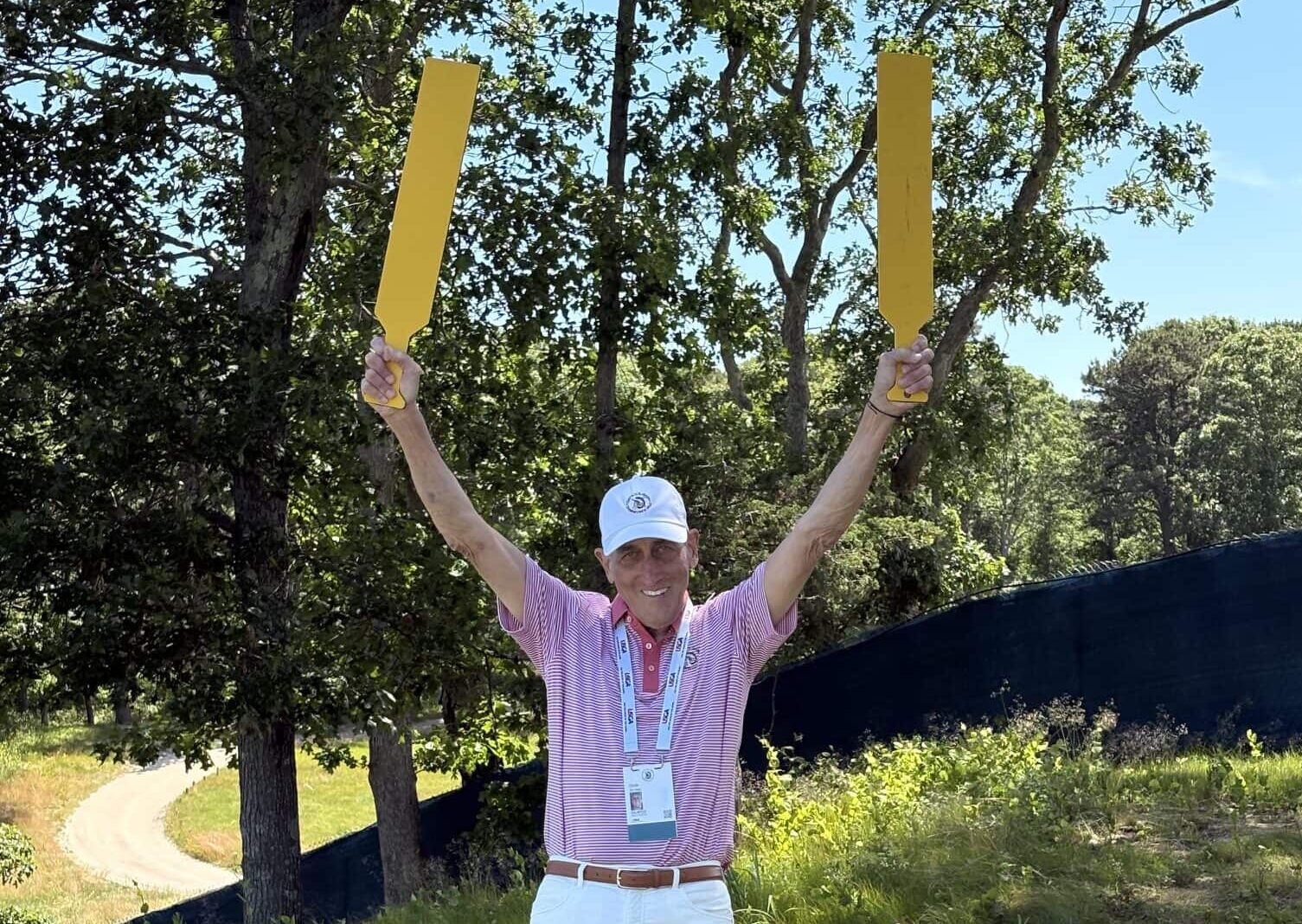
For Steven Zellman, getting to Hole No. 3 at Shinnecock Hills was more than a casual stroll across a golf course. It was, in his words and by any reasonable East End measurement, “a schlep” to reach his volunteer post.
Once he arrived, however, Zellman found himself in one of the most unusual seats at the U.S. Open.
There were no grandstands and virtually no spectators in his section of the hole. It was just the volunteers, the players and the occasional reminder that even the best golfers in the world can become frustrated with a small white ball.
“It was so calm out there,” Zellman explained to me. “You really got to see the players up close and experience what was happening without all the noise.”
Zellman was volunteering in a position reserved for his home golf course in Montauk, which regularly receives an opportunity to work Hole No. 3 when a major championship comes to Shinnecock Hills. His assignment involved operating the paddles used to communicate and help manage play.
From our conversation, it became clear that operating those paddles is something like serving as an air traffic controller—only with golf balls arriving instead of airplanes. “The number one thing about volunteering is that you’ve got to know your job,” Zellman said. “And definitely don’t make noise with the paddles.”
It sounds simple enough until Scottie Scheffler, Brooks Koepka, Tommy Fleetwood or Xander Schauffele is standing nearby preparing to hit. At that point, an innocent rattle from a paddle could suddenly feel like a cymbal crash at Carnegie Hall.
Zellman also came away with a new appreciation for the volunteers who move and manage the gallery ropes. “The ropers have a thankless job. It can be really stressful, but everybody had this happy-to-help attitude.”
That attitude was evident throughout the championship. Volunteers came from across the country, but Zellman was particularly excited to see how enthusiastically the Hamptons community turned out. For a tournament drawing worldwide attention, much of the behind-the-scenes work was being done by familiar local faces.
The USGA, Zellman noted, made sure those volunteers were well looked after. There was an air-conditioned area for breaks, a hospitality tent, food, and two official shirts (which were heavily discounted, and the volunteers were allowed to keep).
Practice days were Zellman’s favorite. The players were more relaxed, occasionally conversational and not yet carrying the full weight of championship competition.
“That’s the best day to be out there,” he said. “Everybody is a little more loose.”
Even relaxed, the professionals offered a striking demonstration of just how different their game is from the one most of us play. Zellman, whose personal best round at Shinnecock Hills is a more-than-respectable 92 (and 75 as a golfer), was astonished by both the distance and the sound of their drives.
“The best part was seeing how far they can hit the ball,” he said. “And the sound is completely different from when amateurs hit. You can hear that they’re hitting the sweet spot every time.”
Considering the distance from his post to where some of those drives eventually landed, Zellman may also have the eyesight of a hawk.
The pros’ power did not make Shinnecock Hills any less punishing. Zellman described the greens as being “like ice”—fast, firm, and difficult even for club members who know their contours. He also witnessed enough wayward shots to confirm that Shinnecock has little interest in protecting anyone’s confidence, regardless of world ranking.
One player sent a ball out of bounds, then found another particularly unpleasant destination that Zellman jokingly called “the toilet.”
Seeing the game at that level also led Zellman to discuss the long road players take to reach major championships, including the Korn Ferry Tour’s role as a pathway to the PGA Tour. Talent may be obvious when the ball leaves the clubface, but reaching that tee requires years of competition, travel, and persistence.
For those inspired by the tournament but not quite ready for Shinnecock’s icy greens, Zellman recommended starting somewhere considerably friendlier. Poxabogue and Sag Harbor, he suggested, are both excellent places for beginners to learn the game without feeling as though every missed putt will be televised internationally.
Zellman turned serious to offer one final piece of golf wisdom: Always pay your golf debts, no matter how small.
After walking miles, managing paddles, watching towering drives and standing only feet from some of the world’s best players, Zellman’s excitement is understandable. Away from the tournament’s largest crowds, Hole No. 3 offered a more intimate, and ultimately more memorable, view of the action. For a volunteer who knew his job (and kept his paddles quiet), it was a rare opportunity to experience championship golf at its most powerful, personal, and wonderfully human.

![Sculpture @ Sylvester Manor: [R]evolution](https://hamptons.com/wp-content/uploads/event-manager-uploads/event_banner/2021/07/manor_house-350x350.jpg)


